ChatGPT Generates the Idea, Builder Assembles the Robot: Future of Algo Trading or Temporary Hype?

“Describe me a strategy based on EMA crossover with an RSI filter.”
ChatGPT delivers the logic in 10 seconds. I open TSLab, assemble the blocks. In 15 minutes — a ready robot.
Sounds like a dream. But does it work in practice?
For the past month I’ve been testing the combo: AI for idea generation, visual builders for assembly. Here’s the reality.
What the AI + Builder Combo Promises
The idea is simple:
-
AI generates a strategy (ChatGPT, Claude) — You describe the idea in text, AI gives the logic: entry/exit conditions, filters.
-
Builder assembles the robot (TSLab, Designer, fxDreema) — You transfer the logic to blocks, run a backtest, robot is ready.
Experiment: 10 Strategies from ChatGPT → TSLab
I asked ChatGPT to generate 10 simple strategies.
Prompt:
“Suggest a simple indicator strategy for daily stock trading. Use only classic indicators (SMA, EMA, RSI, MACD, Bollinger Bands). Describe entry and exit conditions.”
Results out of 10 strategies:
- 3 showed profit on backtest (>20% annual)
- 5 were around zero (+5% to -5%)
- 2 were unprofitable (-10% and -15%)
Problem #1: AI Doesn’t Understand Market Context
ChatGPT generates logically correct strategies. But it doesn’t know: the instrument’s specifics, the current market regime, or your trading style.
Example: I asked for a strategy for BTC/USDT (crypto, high volatility). ChatGPT suggested a 2% stop-loss. On crypto, 2% is noise. The bot got stopped out 20 times a day.
Conclusion: AI needs very precise direction. “Strategy for a volatile asset with 5-10% daily swings” gives better results than just “crypto strategy.”
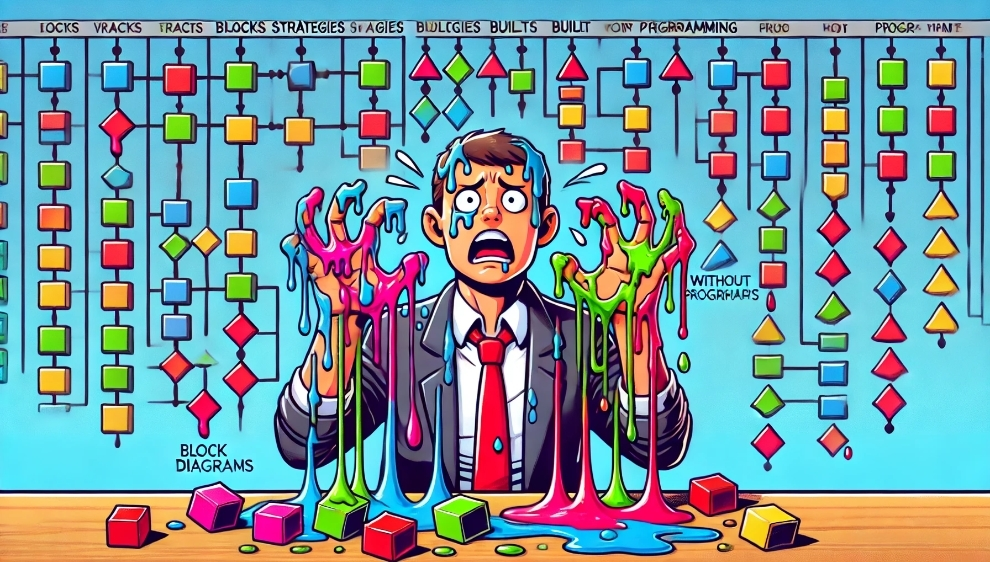
Problem #2: Builders Limit Complexity
Claude can generate complex strategies with adaptive parameters and ML filters. But the visual builder doesn’t support that.
Conclusion: AI can generate a strategy more complex than a builder can assemble.
Problem #3: AI Hallucinates Indicators
ChatGPT sometimes suggests indicators that don’t exist in the builder. TSLab doesn’t have Ichimoku out of the box. fxDreema doesn’t have OBV.
Conclusion: You need to know which indicators exist in your builder. Otherwise AI will propose what can’t be implemented.
What Works: The Right Prompts
After a month of testing, I found the formula for a working prompt:
Bad prompt: “Come up with a trading strategy”
Good prompt: “Suggest a strategy for hourly EUR/USD candles (forex). Use only these indicators: SMA, EMA, RSI, MACD. Average pair volatility 50 pips per day. Goal: 3-5 trades per week. Stop-loss up to 30 pips.”
Real Workflow: How I Use AI + Builder
Step 1: Generate ideas via AI — get 5 ideas, pick the best 2.
Step 2: Assemble in builder — 15-20 minutes per strategy.
Step 3: Backtest — run on 3 years of history. If it fails, go back to AI for adjustments.
Step 4: Optimization via AI — “Backtest showed Sharpe Ratio 0.8. How to improve?”
Bottom line: AI doesn’t replace the analyst. But it accelerates hypothesis generation.
Future or Hype?
It’s not the future. It’s a tool.
AI + builders won’t replace a quant programmer. But they’ll speed up the work.
When it makes sense: Rapid prototyping, generating variations, explaining others’ strategies.
When it’s pointless: Production-ready systems, complex strategies (ML, arbitrage), deep understanding of algo trading.
My opinion: A useful tool for beginners and experienced traders alike. Lowers the entry barrier. But not a silver bullet. If you want deep understanding — learn programming.
Useful links:
Share this article:
Related Posts





























Discussion
Join the discussion in our Telegram chat!