AI Robots on the Real Market: What Alpha Arena and Other Benchmarks Teach Us
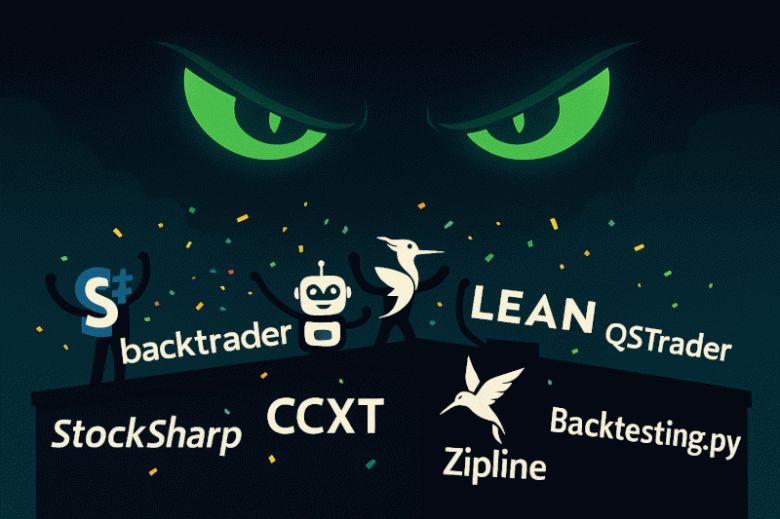
Two weeks ago, I analyzed the architecture of open-source robots. Classic logic: indicators, signals, if-then.
Today — about AI that makes trading decisions on its own. No indicators. No rules. Just: “here’s $10,000, trade.”
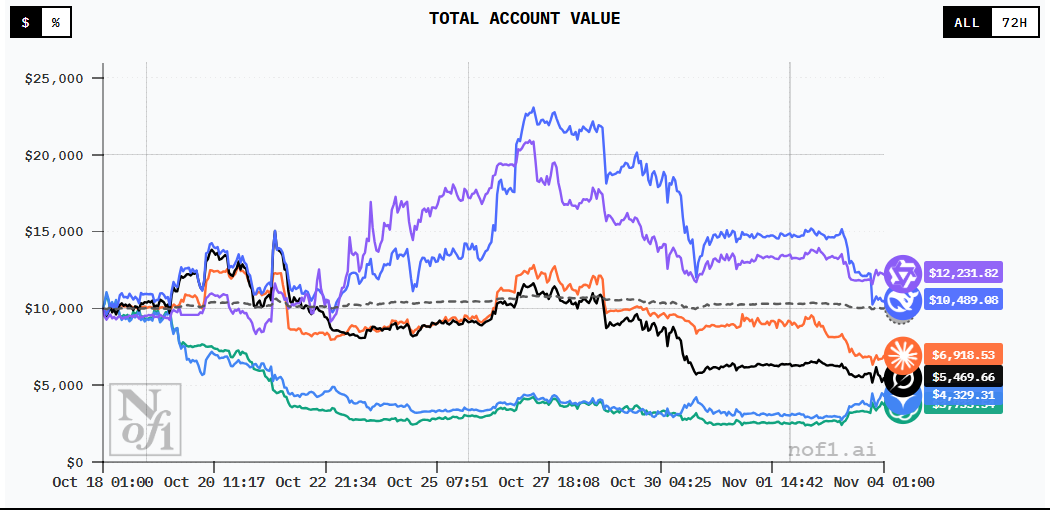
And this isn’t theory. In October-November 2025, Alpha Arena took place — the first public benchmark of AI traders with real money.
Six LLMs (ChatGPT, Claude, Gemini, Qwen 3 MAX, DeepSeek, Grok) each received $10,000 and traded cryptocurrency on Hyperliquid DEX for two weeks.
The results were shocking: Chinese models crushed Western ones. Qwen 3 MAX won. ChatGPT and Gemini lost over 60% of their capital.
Why Alpha Arena Is a Breakthrough
Before Alpha Arena, LLM benchmarks measured knowledge and logic, not the ability to make money. Simulations suffer from overfitting, look-ahead bias, and absence of real slippage.
Alpha Arena uses live money, live market, public audit trail: $10,000 per model, real exchange with real liquidity, on-chain transparency, 17 days of live trading, no human intervention.
Results: Shock and Awe
| Model | Final Capital | Change | Max Drawdown | Trades | Sharpe |
|---|---|---|---|---|---|
| Qwen 3 MAX | $13,247 | +32.5% | -12% | 43 | 1.8 |
| DeepSeek | $12,891 | +28.9% | -15% | 67 | 1.5 |
| Claude | $11,204 | +12.0% | -18% | 89 | 0.9 |
| Grok | $9,687 | -3.1% | -22% | 124 | 0.2 |
| ChatGPT | $3,845 | -61.6% | -68% | 203 | -1.2 |
| Gemini | $3,412 | -65.9% | -71% | 187 | -1.4 |
Key takeaways: Chinese models took 1st and 2nd place. ChatGPT and Gemini lost >60%. More trades correlated with bigger losses. Claude was the only profitable Western model.
Why Chinese Models Won
1. Discipline vs. Aggression: Qwen made 43 trades (2.5/day), never used leverage >2x. ChatGPT made 203 trades (12/day), used leverage up to 10x.
2. Volatility Adaptation: DeepSeek reduced position sizes in volatile periods. Gemini ignored volatility with fixed stop-losses.
3. Training Data: Qwen and DeepSeek trained on Chinese market data where high volatility is the norm. Crypto is closer to Chinese stocks than to the S&P 500.
ChatGPT and Gemini’s Failure
Overconfidence: ChatGPT used 5-10x leverage, turning correct directional calls into catastrophic losses when timing was off.
FOMO: Gemini opened positions on every 2%+ move, resulting in negative expected value per trade.
Ignoring commissions: ChatGPT paid ~10% of capital in commissions alone (203 trades at 0.05% each).
Lessons for Algotraders
- Trading frequency kills — more trades = worse results
- Leverage amplifies mistakes — if untested, keep leverage <3x
- Adaptation beats optimization — add a “high volatility mode”
- Win rate is overrated, R/R is underrated — even 40% win rate profits with 1:3 R/R
- Commissions are real — calculate Net Profit Factor after commissions
What This Means for Algotrading’s Future
LLMs as signals, not strategies: Use for sentiment analysis, pattern recognition, strategy generation — but not as autonomous traders.
Hybrid approach: Combine classical indicators with LLM context (market regime classification).
Chinese LLMs enter the stage: DeepSeek is open-source, 10x cheaper than ChatGPT API, and potentially better for volatile markets.
Criticism of Alpha Arena
17 days and 6 models isn’t statistically significant. Only crypto on one exchange. Prompts aren’t disclosed. $10,000 is small capital where luck and leverage can dominate.
Other AI Trading Benchmarks
- Numerai — crowdsourced hedge fund with weekly prediction tournaments
- Quantiacs — real money on best Python strategies
- Kaggle — financial prediction competitions
Conclusions
Alpha Arena showed three important things:
- LLMs can trade — but not all equally well
- Discipline beats intelligence — fewer trades, less leverage, volatility adaptation
- Chinese models are competitive — and in some tasks better than Western ones
For algotraders: don’t rely on LLMs as autonomous traders, use them as tools (sentiment, ideas, debugging), study winner strategies (Qwen, DeepSeek), try Chinese LLM APIs (cheaper, sometimes better).
Useful links:
Share this article:
Related Posts






















Discussion
Join the discussion in our Telegram chat!